
There's a folder on most photographers' hard drives — or in most photographers' cloud storage, or on most photographers' memory cards — full of photos that never got edited. The photos are fine. The intention was there. But somewhere between getting home and actually sitting down to process them, the moment passed.
This happens to professionals too, not just casual shooters. But casual shooters experience it almost universally. You come back from somewhere with good light and a full card. You'll edit them this weekend. Then it's not that weekend, it's the next one. Then the card fills up again. Eventually the photos from the good-light evening live permanently in a "to edit" folder that becomes a graveyard.
The Activation Energy Problem
Behavioral economists use the term "activation energy" to describe the upfront cost of starting a task. The higher the activation energy, the more motivation required to begin — and motivation is a finite resource that competes with tiredness, competing priorities, and the general friction of daily life.
Photo editing has historically had high activation energy. Launch an application. Wait for it to load. Import the files. Wait for previews to generate. Find the right catalog. Remember the keyboard shortcuts you haven't used in three weeks. All of this is minor friction individually. Collectively, it's enough friction that a tired person at 9pm decides to do it tomorrow.
“The best camera is the one you have with you. The same logic applies to editing software.”
— Attributed to various photographers, on cameras. We think it generalizes.
What Low-Friction Actually Looks Like
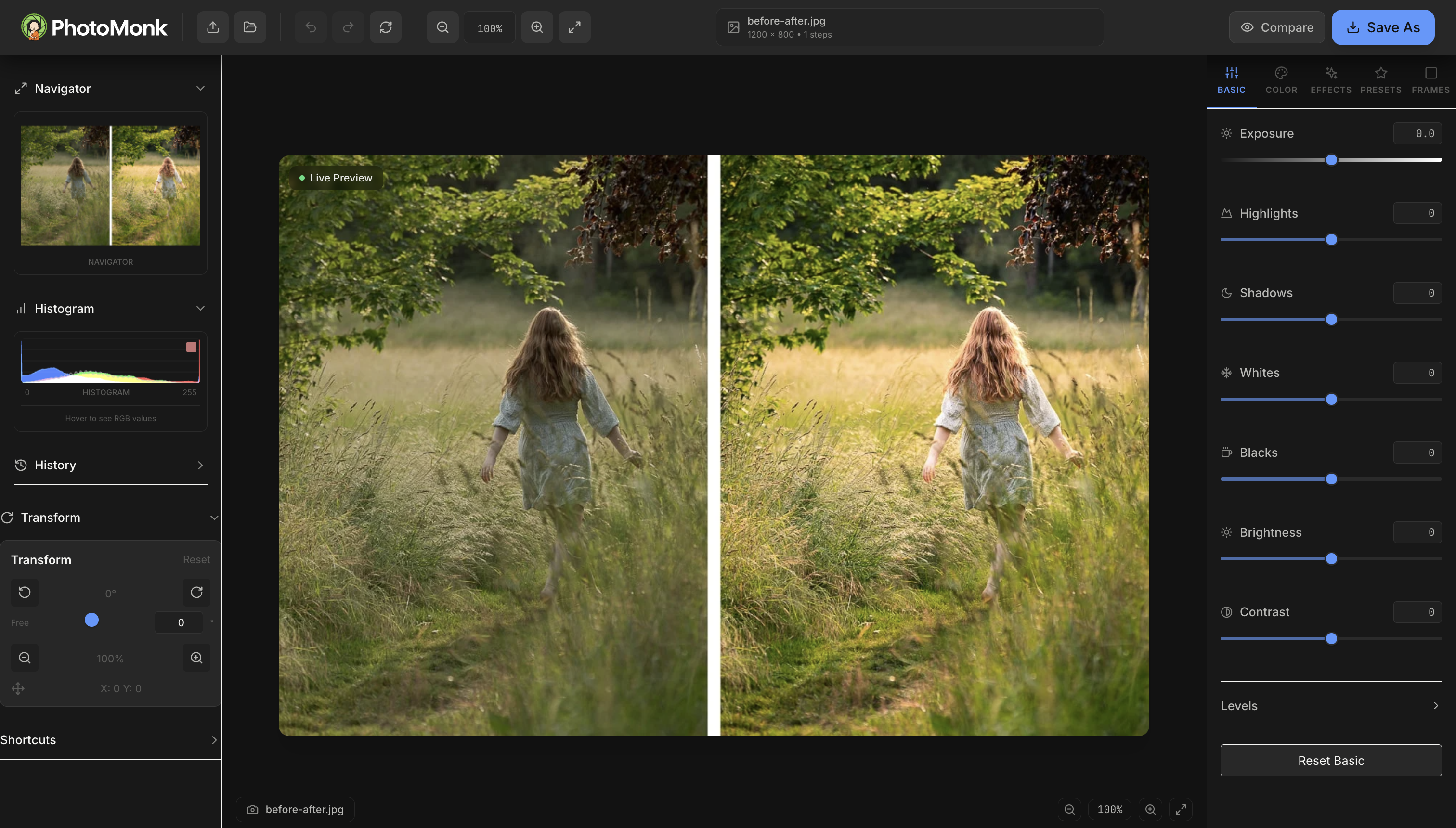
We thought about this a lot when building PhotoMonk. The goal wasn't just to build a capable editor — capable editors exist. The goal was to build an editor that removes every unnecessary step between you and the photo.
No installation. You don't download anything. The editor is a URL. Open it in a browser tab and it's there.
No account. You don't create a profile, verify an email, or choose a password. There's nothing to log into.
No import step. Drag a file onto the editor. It opens. That's the workflow.
No subscription prompt interrupting the session. No banner asking you to upgrade. No features locked behind a payment tier.
From a cold start — no tab open, no account — to looking at your photo with sliders available, the time is under thirty seconds. Usually less.
The Trade-Off
The low-friction approach means PhotoMonk doesn't try to be a full catalog management system. There's no database tracking which photos you've processed, no ratings, no tags, no smart albums. If that organizational layer is central to your workflow, you'll want a tool that provides it.
But for a lot of photographers — especially those whose "to edit" folder keeps growing — the catalog isn't the bottleneck. The bottleneck is the activation energy required to open the software and start. PhotoMonk is built for that.
There are no steps between you and your photo. Open PhotoMonk. Drag in a file. Edit it. That's the entire workflow — and it takes about as long as reading this sentence.
The Photos That Get Edited
In our experience, the photos that get edited are the ones where starting was easy. The tool was open. The file was nearby. No decision had to be made about which catalog to use or whether the software needed an update. The conditions were right for starting, so the work got done.
We built PhotoMonk to make those conditions exist by default, not by accident. If you have a folder of unedited photos that have been waiting for the right moment: the moment is now, the tab is one click away, and there's nothing standing between you and getting started.
“We think the photos you take deserve to be edited. We're just trying to make that as easy as possible.”
— PhotoMonk team